
Golden Hour Photography: How to Find and Shoot the Best Light of the Day
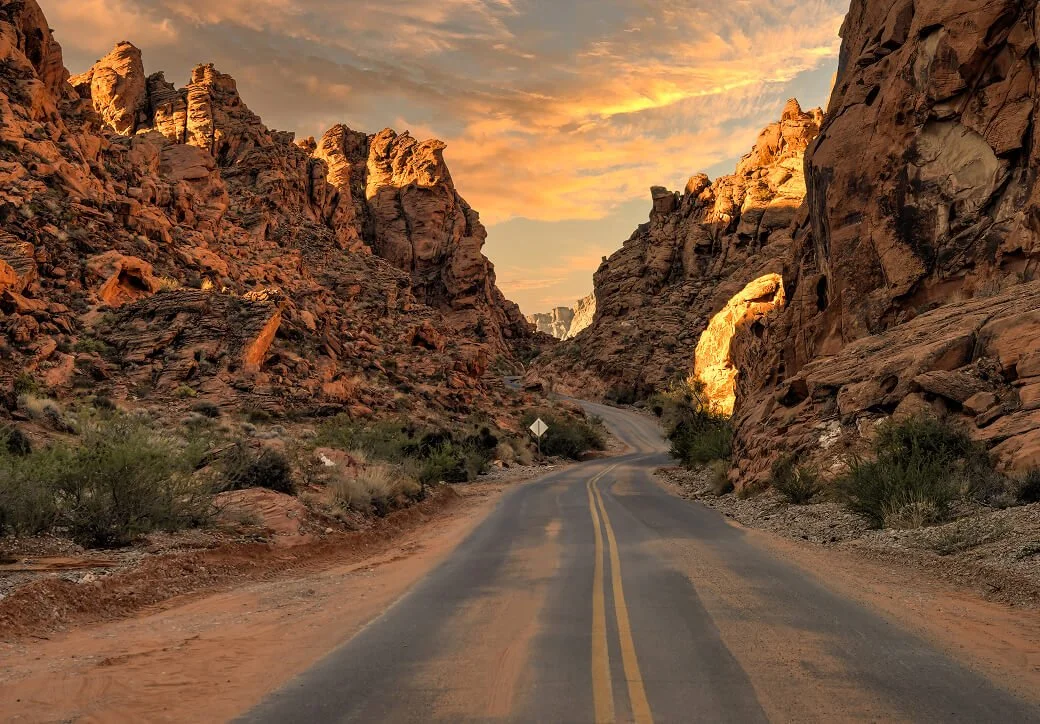
I have spent a lot of time waiting. Standing in an abandoned mill in Lawrence, Massachusetts at 6:40 in the evening, watching the sun drop toward a gap between two rooftops, knowing I had about eighteen minutes before the light coming through the west wall would stop being interesting. Golden hour photography is mostly waiting. The shooting, when it happened, took three minutes.
Every guide tells you to shoot at golden hour. Most skip the part where you figure out whether it will actually happen that day, which direction the light will come from, and how to handle it when it moves faster than expected.
These golden hour photography tips come from real locations and real failures: how to read the sky the day before, what to do with the light when it shows up indoors, and what the camera settings actually need to be doing.
Table of Contents
1. What Golden Hour Actually Is
2. When Golden Hour Happens Where You Are
3. Reading the Sky the Day Before
4. Camera Settings for Golden Hour
5. Five Ways to Use the Light
6. Golden Hour Indoors and Through Broken Windows
7. Golden Hour in Cities
8. What Not to Shoot at Golden Hour
9. After the Sun Goes Down
10. Editing Without Ruining It
11. Final Thoughts
12. Golden Hour Photography FAQs
What Golden Hour Actually Is
Golden hour is the period when the sun sits between roughly six degrees below and six degrees above the horizon, just after sunrise and just before sunset. The light during this window has a color temperature of around 3,000 to 4,000 Kelvin, compared to midday's 5,500K, which is why skin, brick, rust, and wood all look warmer and more dimensional than they do at noon. Understanding what is golden hour in photography means understanding a lighting condition, not a fixed time: it can last fifteen minutes in the tropics or most of a winter afternoon in Iceland.
Why Low Sun Turns Warm
When the sun is low, its light travels through far more atmosphere than it does at noon. The blue and violet wavelengths scatter out along the way, a process called Rayleigh scattering. What arrives at your lens is the warm end of the spectrum that survived the longer path. The physics behind it also explains why the effect varies so much by location, season, and air conditions.
The Bit Most Guides Get Wrong
The common assumption is that dust and pollution make golden hour more vivid, but the opposite is true. Haze desaturates the light and turns oranges into flat pale yellows. The strongest golden hour color comes on clean air, typically the evening after a weather front has moved through.
In practice I check air quality alongside the cloud forecast. The best light I have shot has almost always followed rain. The air is cleaner, the surfaces are wet and reflective, and there’s often a sharp edge between the clear air behind the front and the cloud that came with it.
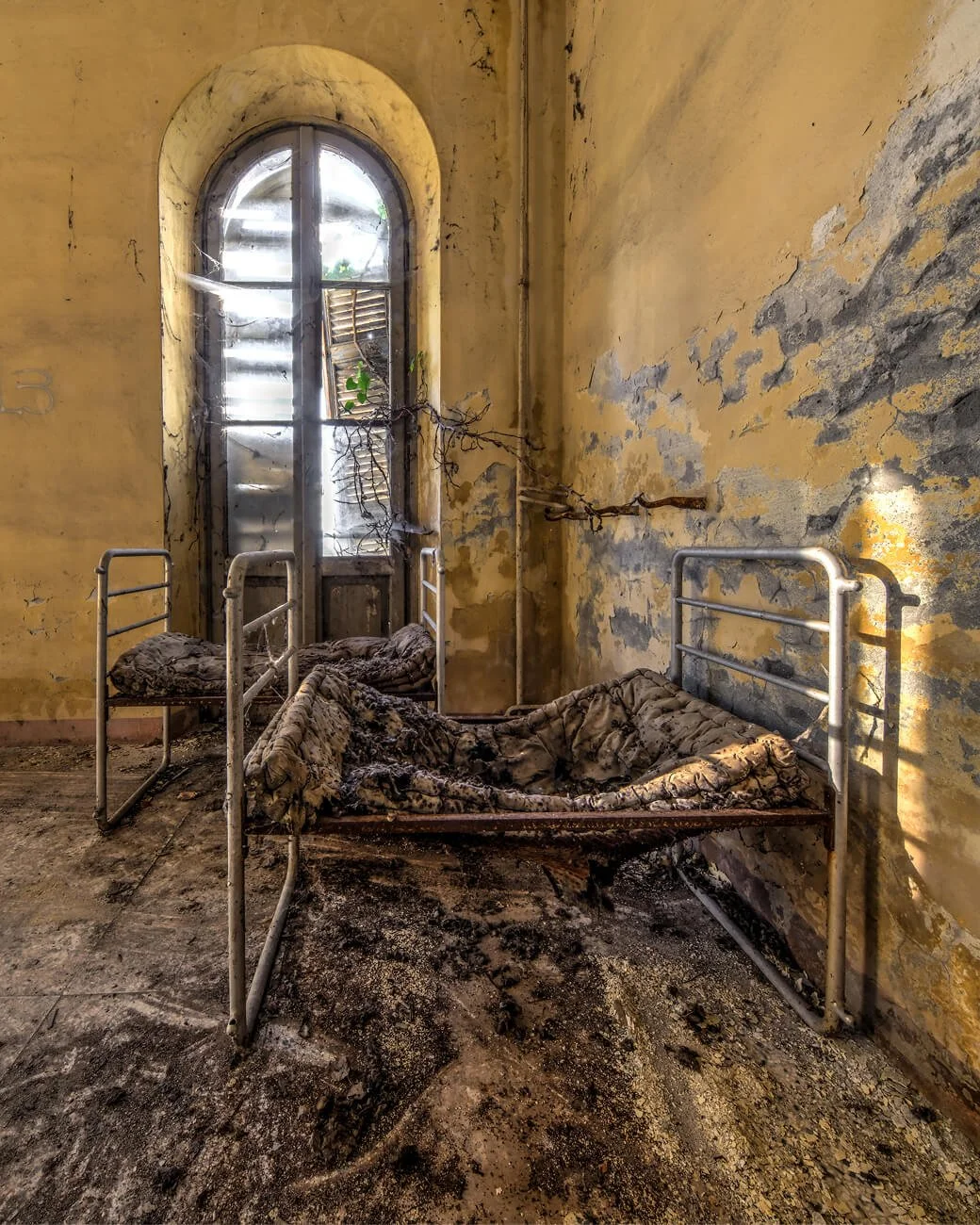
The name is misleading. Depending on your latitude and the season, the window can be as short as fifteen minutes or as long as most of the afternoon. How long does golden hour last? Here is a table by latitude.
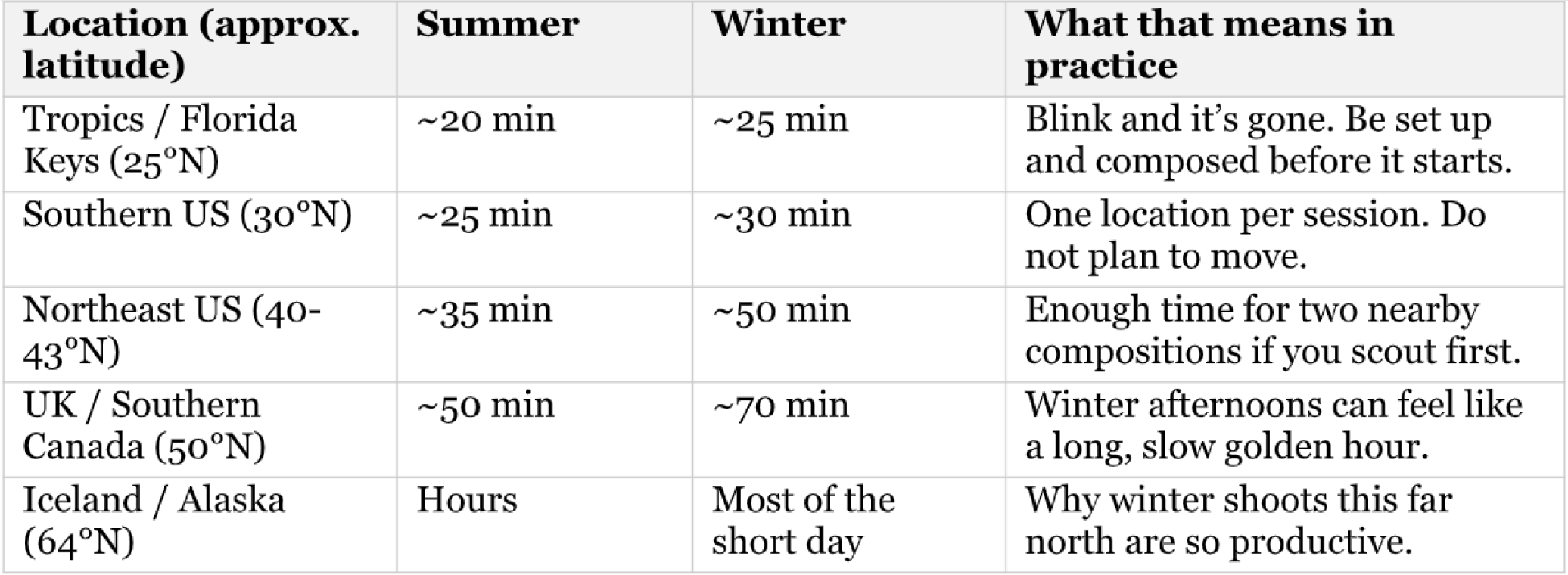
These are typical numbers. Cloud cover and terrain will shift them.
Planning the Direction, Not Just the Time
When is golden hour matters less than where the sun will be at that moment relative to your subject. A location that works in October won’t work in June because the azimuth has moved. I can scout a specific wall of a brick building one fall, come back in May, and find the sun setting behind the building entirely.
I see exactly where the sun will sit over a location at a specific time and date before I drive anywhere. It shows the azimuth, shadow length, and how both change through the day.
Morning vs Evening
Dawn gives cleaner air, mist and dew, and cooler tones. The commitment is higher: you have to be in position in the dark before you know whether it will pay off. Dusk builds in front of you. There is more atmospheric dust by the end of the day so the light runs warmer and slightly hazier, and you can watch it develop and adjust as it does. My preference is dusk, mainly because the light gets better as it goes rather than peaking early.
The Long Golden Hours of Winter
In midwinter at northern latitudes the sun never climbs high, so the whole afternoon can behave like golden hour. That changes the planning completely. Less urgency, more time to explore and find the right composition rather than committing to one spot and waiting.
Reading the Sky the Day Before
A forecast showing 70 percent cloud tells you almost nothing useful. Cloud height is what matters, not cloud cover.
I check this the night before, not the morning of. A cirrus layer moving in from the west by evening is a good sign if it thins out toward sunset rather than thickening. I look at cloud base height specifically, not just percentage cover, since most forecast apps rarely separate the two clearly.
A high cloud-cover percentage can still produce excellent light if the layer is thin and high enough to catch the reddened sun from above the haze. A low, thick deck at the same percentage kills the light entirely. The number alone tells you almost nothing. What matters is what kind of cloud is sitting where, and that only comes from checking layer height.
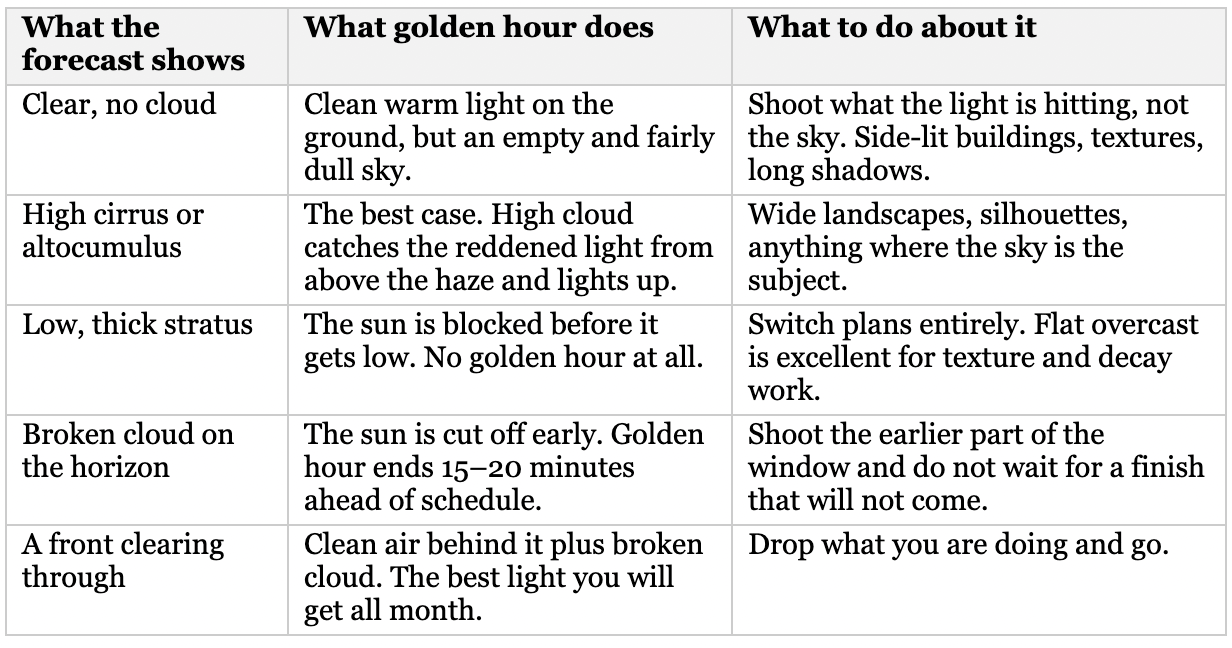
The front-clearing scenario is the one I prioritize above everything else. I’ve missed it in the past by waiting to see if the conditions held. Now I just go.
Camera Settings for Golden Hour
These aren't settings pulled from a general guide. They're what I actually dial in once I'm standing in front of the light, adjusted from years of getting it wrong first.
Expose for the Highlights
Shooting into low sun fools the meter. I dial exposure compensation down a third to a full stop and let the shadows go dark. Recovering shadow detail in RAW is straightforward. Recovering a blown sky isn’t. I watch the histogram rather than the back-screen for this.
White Balance and the Warmth Trap
Auto white balance neutralizes the warmth, which defeats the purpose. I set Cloudy or Shade, or dial Kelvin manually between 6,000 and 7,500K, so the camera matches what I’m actually seeing. The trap is overcooking it: push too far and skin turns orange and greens go dead. I shoot RAW so the decision stays reversible in Lightroom.
Aperture, Sun Stars and the Trade-off
f/16 to f/22 with the sun partly hidden behind a hard edge gives a clean sun star. Wide open at f/1.8 to f/2.8 separates a subject against a glowing background. The trade-off nobody mentions: f/22 softens the whole frame through diffraction. f/16 is usually the smarter stop. A dirty front element turns any backlit frame into milky haze. Clean the glass first.
When to Bracket and When Not To
If the sun is in the frame, bracket. The range between the sun disk and the shadow areas exceeds what any sensor holds in a single exposure. If the sun is behind you lighting the subject, a single well-exposed RAW is enough. Bracketing during a short window just slows you down.
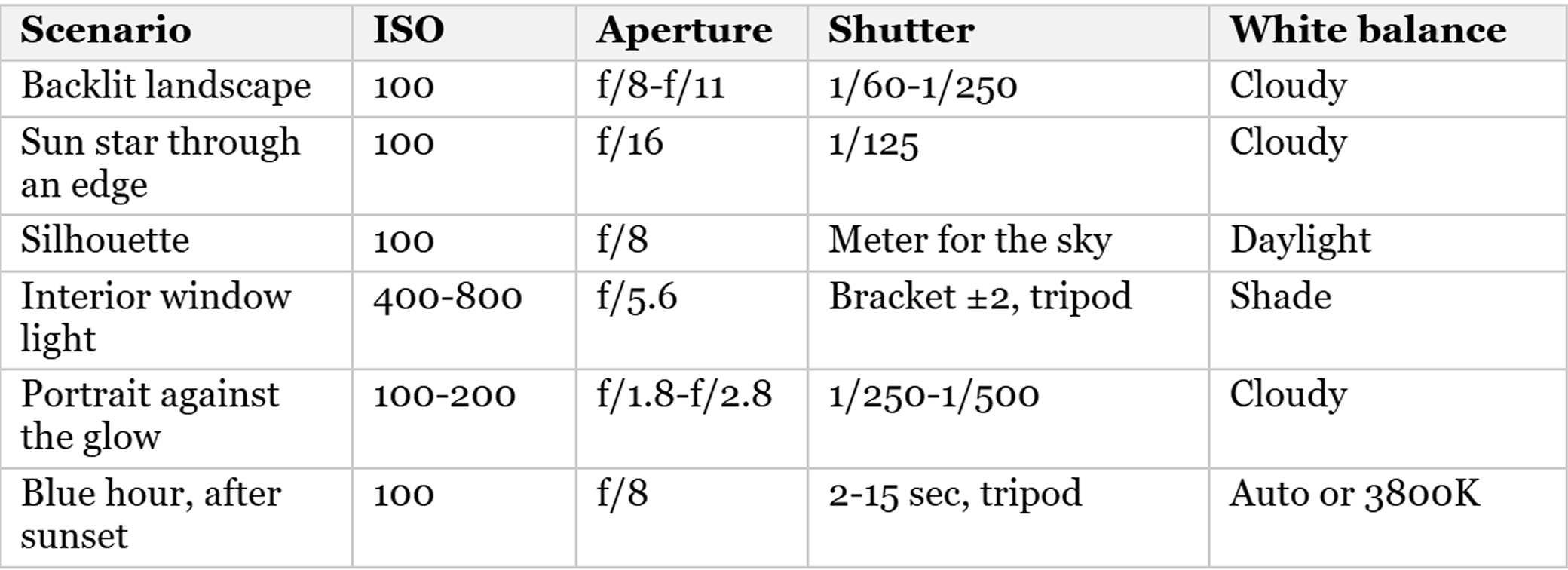
A Starting Point for Golden Hour Camera Settings
Use these as a starting point. The light will tell you what to adjust
Five Ways to Use the Light
Front Light
Sun behind you, subject directly lit. This is warm, even, and the easiest of the five to get right, which is exactly why it gets overused. The risk is flatness: front light removes shadow, and shadow is what gives a scene its sense of depth. Without it, even a well-exposed frame can feel strangely empty. It works best when the subject already has strong color or texture doing the work, since front light won't add dimension on its own.
Side Light
The most useful type for my work. Raking light crosses a surface and makes every ripple in peeling paint, every ridge in brickwork, every seam in rusted metal readable in a way that overhead light never does. Long shadows become compositional elements rather than incidental marks.
Side light at golden hour on an east- or west-facing facade tends to be the most reliable combination, since the sun's low angle rakes directly across the surface rather than hitting it head-on.
Backlight and Rim Light
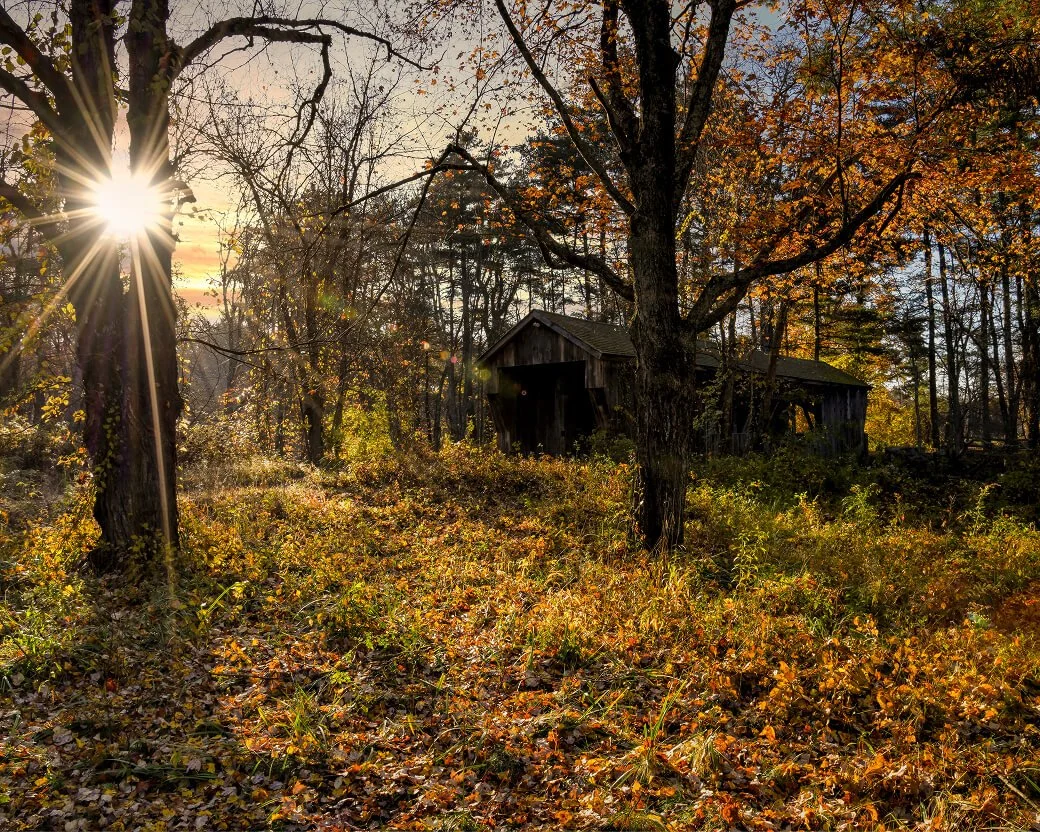
Sun behind the subject. Edges pick up a warm rim of light and separate cleanly from the background, which is what gives this kind of shot its sense of depth. When there's dust or mist in the air, the light itself becomes visible, almost tangible. The risk is flare washing out contrast and flattening the whole frame. I shade the front element with my hand, or shift position slightly until a building or branch blocks the sun disk from hitting the glass directly.
Silhouettes
Expose for the sky and let the subject go completely black. This only works if the shape is strong and unambiguous on its own, since there's no other detail left to read. A bare tree, a chimney stack, a fire escape against open sky all hold up well. Overlapping shapes at the same exposure level lose their edges and collapse into a single unreadable mass, so keep the silhouette isolated and simple.
Sun Stars and Flare
Partly obscure the sun behind a hard edge and stop down to f/16. The star effect only forms when the disk itself is mostly hidden, not fully exposed. The edge of a roofline works well for this, and so does a window corner or a branch sitting just in front of the disk. Flare is a choice here, so you want to make sure it looks deliberate.
Golden Hour Indoors and Through Broken Windows
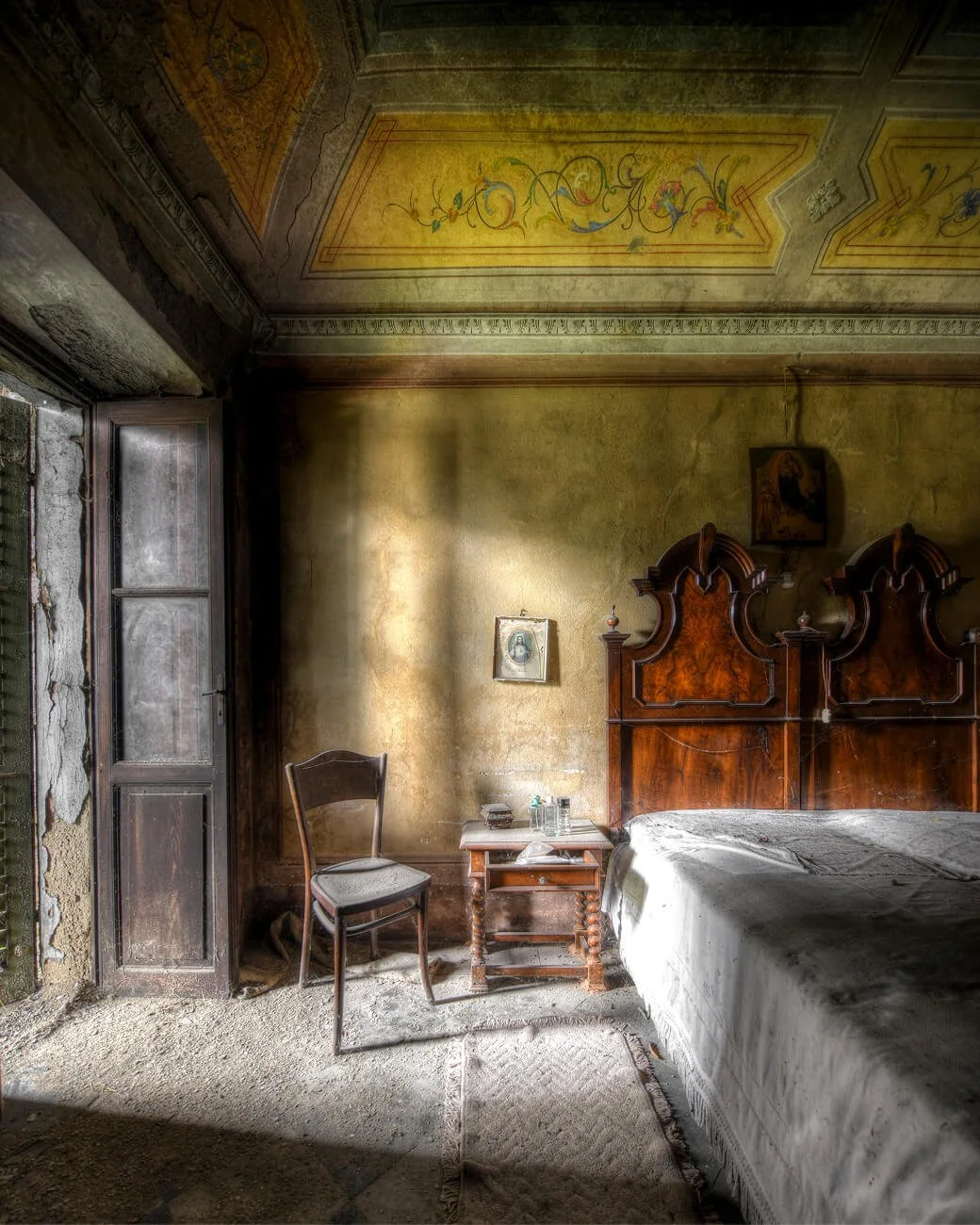
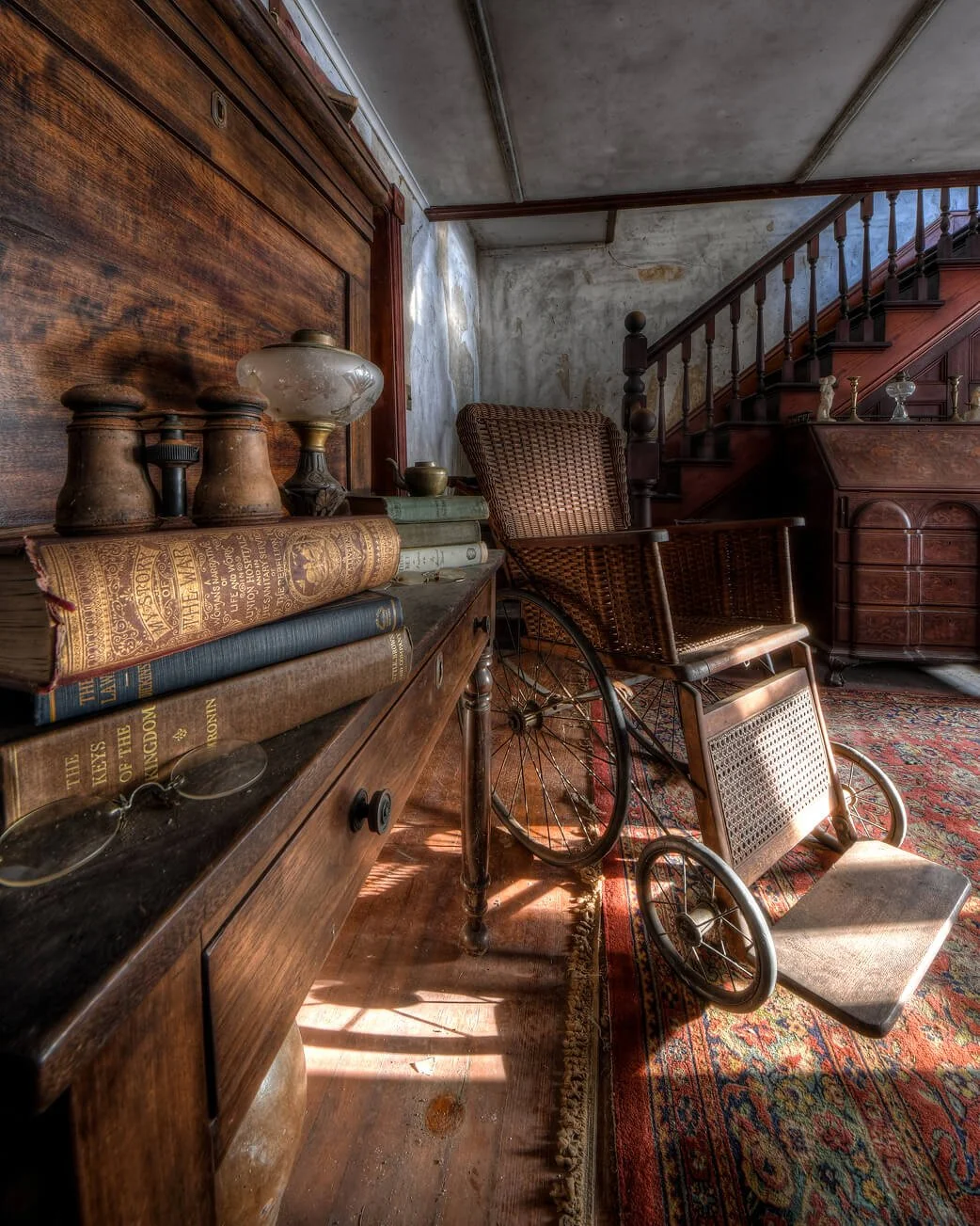
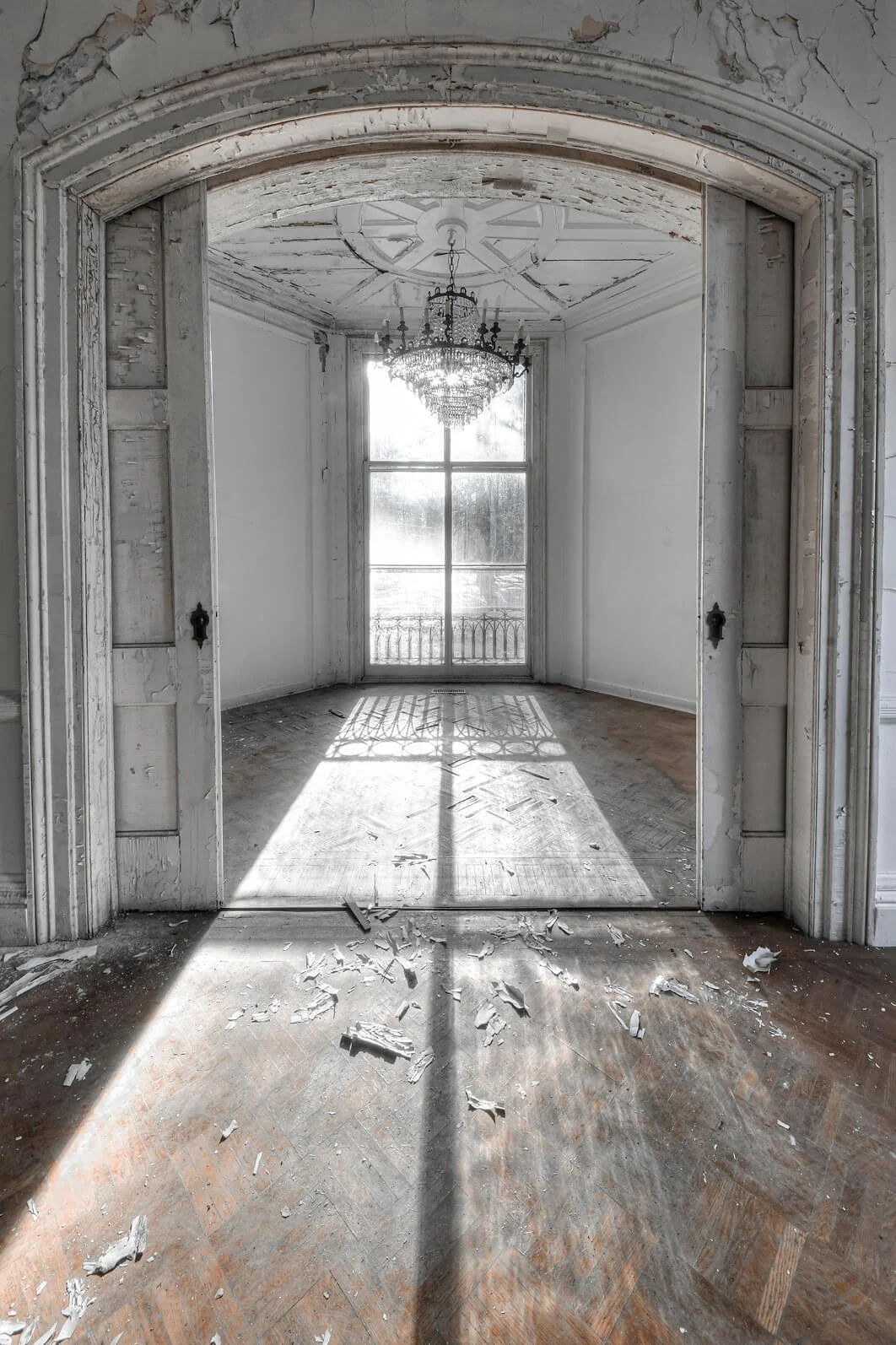
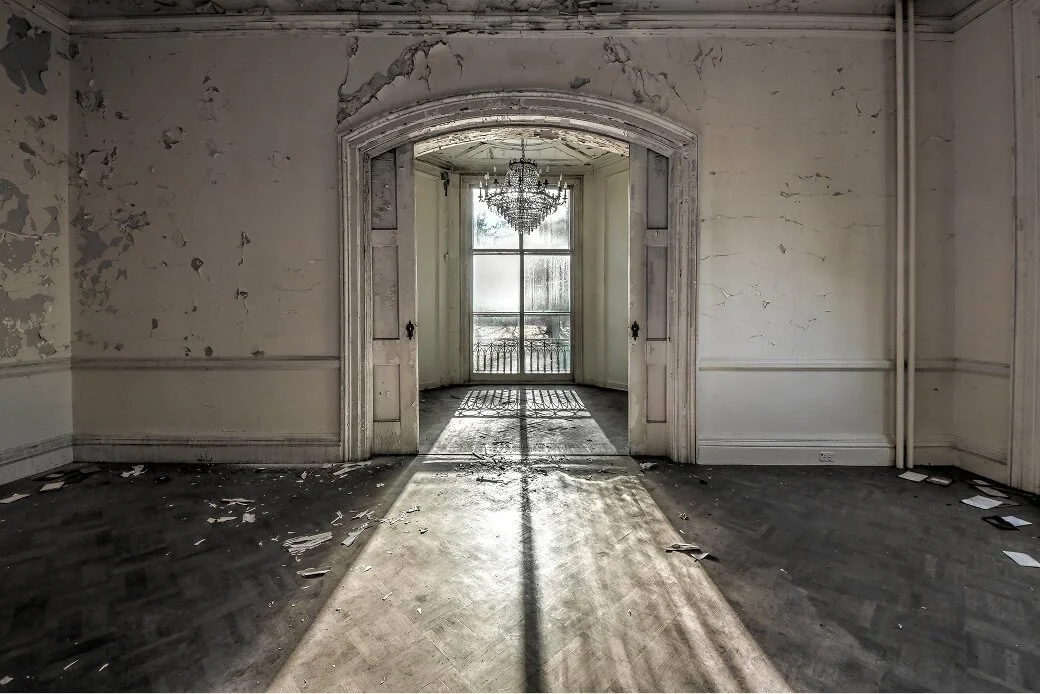
Low sun travels much further into a room than midday sun does. At noon, direct light comes in at a steep angle and hits a narrow band near the window. At golden hour, the same window throws a patch of warm light twenty or thirty feet across a floor. Spaces that are unusable at noon come alive for fifteen to twenty minutes.
The difference is dramatic enough that it's worth returning to the same interior twice: once at midday to scout it, and once at golden hour to actually shoot it. A room that looks flat and unremarkable at noon can turn into the most interesting frame of the day once the angle drops low enough to rake across the floor and pick up every board, nail hole, and spill of dust on the surface. Same room, same camera, completely different material depending on when you show up.
Dust in the air makes the beams visible, which is exactly what you want. In an abandoned building there’s always dust, and disturbing it deliberately by walking through the space before you shoot is fair game. The beams move fast. I compose for where the light will be in two minutes rather than where it is now, because by the time I have focused it has already shifted.
The light doesn't just move across the floor either. It climbs walls, catches the underside of a staircase, slides across peeling paint at an angle that makes every layer visible. I’ve learned to scan the whole room rather than fixating on the beam itself, since the most interesting frame is often where the light lands rather than the beam's source. A room with several openings gives you multiple windows of opportunity as the angle shifts, not just one.
Window orientation decides everything. An east-facing room will never catch direct sun at sunset. I check orientation before I enter a building. For more on working with whatever light a space already offers, the low light photography post covers the full approach, including the extreme dynamic range that comes with a lit window against a dark interior. Bracket every frame here.
Golden Hour in Cities
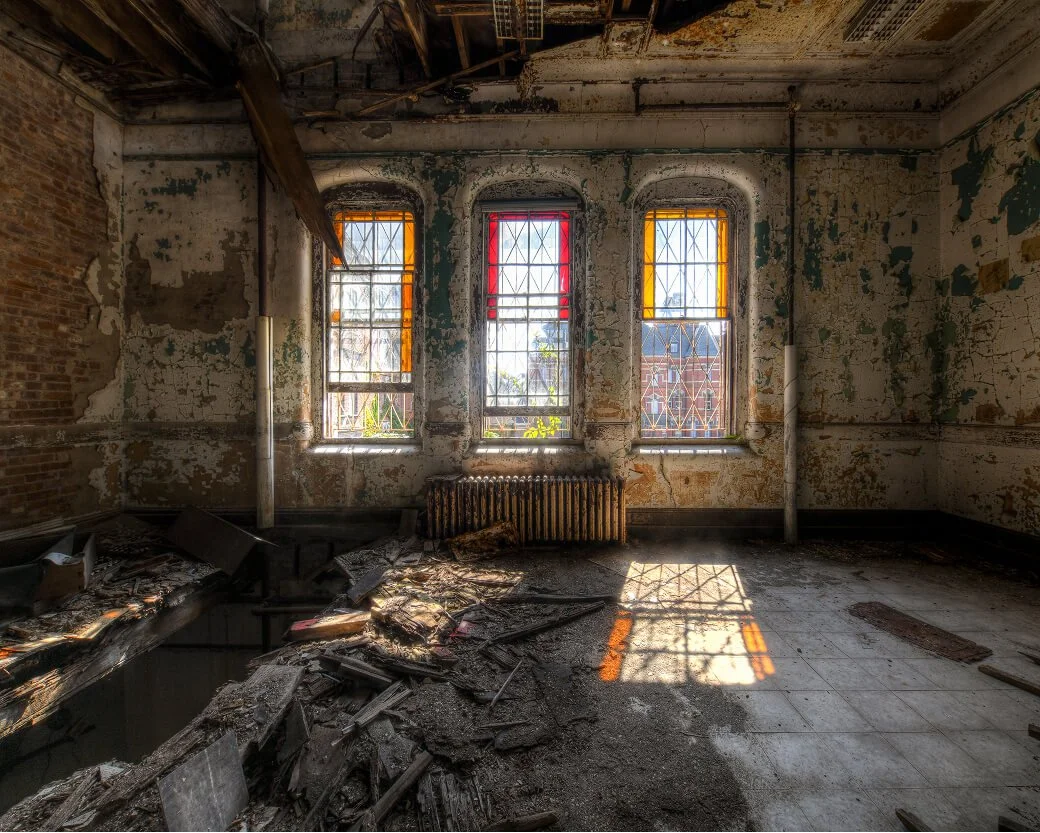
At street level, golden hour often ends twenty to thirty minutes earlier than the calculator says. Buildings block the low sun long before the geometric horizon does. Twenty floors up, the light is still going.
Height changes everything about how this light behaves in a city. A rooftop or a high window can hold direct sun well after the street below has slipped into shadow, which means the same golden hour can be shot twice from two different vantage points with completely different results. Elevators and fire escapes become part of the planning as much as the compass direction does. I've learned to think in terms of sightlines rather than just time of day: what's tall enough nearby to still be catching light when everything at ground level has gone flat.
Some glass towers catch the light on their west face and bounce a second, softer version of it into streets already in shadow to the east. It’s worth learning which buildings in your city do this and at what time of year. West-facing facades hold the light longest. East-facing streets are a morning proposition.
Wet pavement after rain doubles everything, and rain-then-clearing is already the best golden hour weather. For more on finding compositions in a city across multiple sessions rather than a single visit, the urban landscape photography post covers the longer work of reading a city for its light and geometry.
What Not to Shoot at Golden Hour
Warm directional light is a strong flavor, and like any strong flavor, it overwhelms anything delicate enough to need a lighter touch. Most golden hour guides treat this light as an unconditional upgrade, when it isn't. Pretending otherwise leads to a lot of technically warm, visually muddled photographs.
Color-critical texture studies are worse at golden hour. Peeling paint and rusted metal have their own color, and a heavy orange cast fights it. Flat overcast separates the hues and lets the surface read clearly.
Symmetry and architectural detail suffer under hard directional shadows. If the image depends on a balanced read of a facade or an interior, the shadows golden hour creates will break that read. Open shade or overcast is the better call.
Anything intended for black and white conversion loses the main thing golden hour offers. Strip the color and warm light gives you nothing that flat, well-placed contrast on a gray day would not provide.
Documentation work where accurate color matters, cataloguing a building's original paint or recording a material's true condition, should never be shot at golden hour. The cast contaminates the very thing you're trying to record.
The clock shouldn’t decide what you shoot. The light should earn its place in the frame, the same as everything else in it.
After the Sun Goes Down
Most people pack up at sunset and miss the best of it. The ten to twenty minutes of afterglow that follow are often more complex and less orange than the golden hour itself: the sun is below the horizon but still illuminating the underside of clouds and the upper atmosphere.
Blue hour follows, and the difference between golden hour vs blue hour is fundamental. Golden hour is directional, warm, and fast. Blue hour is omnidirectional, cool, and slow. The color temperature of the sky climbs toward 8,000 to 10,000K as the deep atmosphere takes over, giving a flat, low-contrast light that suits long exposures and exterior architectural work.
In cities, blue hour is the one window where artificial light and sky brightness are close enough in level to balance in a single frame without bracketing. It’s short, usually fifteen to twenty minutes. Set up before the afterglow fades.
Editing Without Ruining It
The temptation is to push global temperature until everything reads orange. The problem is that global temperature affects every channel equally: greens go brown and skin turns copper before the warm tones look right.
A better approach is to keep global temperature close to where you shot it, then work in the HSL panel. Lift the luminance of the orange and yellow channels. Drop the saturation of orange slightly if skin is involved. These adjustments do what a global temperature push cannot do cleanly.
Pull highlights down to recover texture in bright sky or water. In a correctly exposed RAW the detail is usually there. The sensor caught most of what you want. Editing here is about protecting what the sensor already recorded rather than manufacturing warmth that wasn't in the original light.
When Golden Hour Happens Where You Are
Final Thoughts
Golden hour rewards showing up more than it rewards gear. I’ve shot in this light with bodies at opposite ends of the range and the difference in outcome was almost entirely about whether I had scouted the location, checked the forecast, and arrived early enough to find the composition before the light started moving.
Most of the time spent at golden hour is waiting.Watching the sun descend, the color shifting on the wall you've set up in front of, and then adjusting the tripod an inch because the shadow fell differently than you expected. That time isn’t wasted. It is where you actually notice the place you are standing in, which is usually what makes the photograph worth taking.
Golden Hour Photography FAQs
Is golden hour actually an hour?
Almost never. The window varies from about fifteen minutes in the tropics in summer to several hours in Iceland or Alaska in winter. At 40 to 43 degrees north, which covers most of the US Northeast, expect thirty-five to fifty minutes depending on the season. Check the table in the second section for numbers by latitude.
What time is golden hour where I live?
It starts roughly thirty minutes before sunset for the evening window and runs roughly thirty minutes after sunrise for the morning window. The exact timing shifts daily with the sun's position. My advice is to use a tool like SunCalc rather than a fixed rule because it shows the azimuth and altitude at any time and location.
What is the difference between golden hour and blue hour?
Golden hour is the warm, directional window when the sun sits near the horizon. Blue hour is the cooler, lower-contrast period after sunset or before sunrise when the sky takes on a deep blue tone. Golden hour moves fast and favors faster exposures. Blue hour almost always means a tripod and multi-second exposures. Together the two windows run roughly ninety minutes on either side of the sun.
What camera settings should I use at golden hour?
The consistent rules: expose for the highlights and let the shadows go dark, set white balance to Cloudy or Shade rather than Auto, and shoot RAW. If the sun is in the frame, bracket. If it’s behind you, a single well-exposed RAW is enough.
Is morning or evening golden hour better?
Morning gives cleaner air, mist, and cooler tones, with the location almost always to yourself. Evening builds in front of you and allows adjustment as it develops. My preference is dusk, mainly because you can watch the light improve and respond to it rather than committing to a setup in the dark before you know whether it will pay off.
Can you get golden hour light indoors?
Yes. Low sun travels much further into a room than midday light does, and in a space with west-facing windows, the light comes in at an angle that reveals texture and creates visible dust beams. The window orientation determines everything: only a west-facing window catches direct light at sunset. The dynamic range is extreme, so bracket and work from RAW.